From solving to inferring
Every AI surrogate, whatever its architecture, makes the same basic trade. A conventional solver decomposes the design into a computational mesh, often tens of millions of cells, and iterates a coupled system with at least that many unknowns until it converges, often thousands of cycles on an HPC allocation.
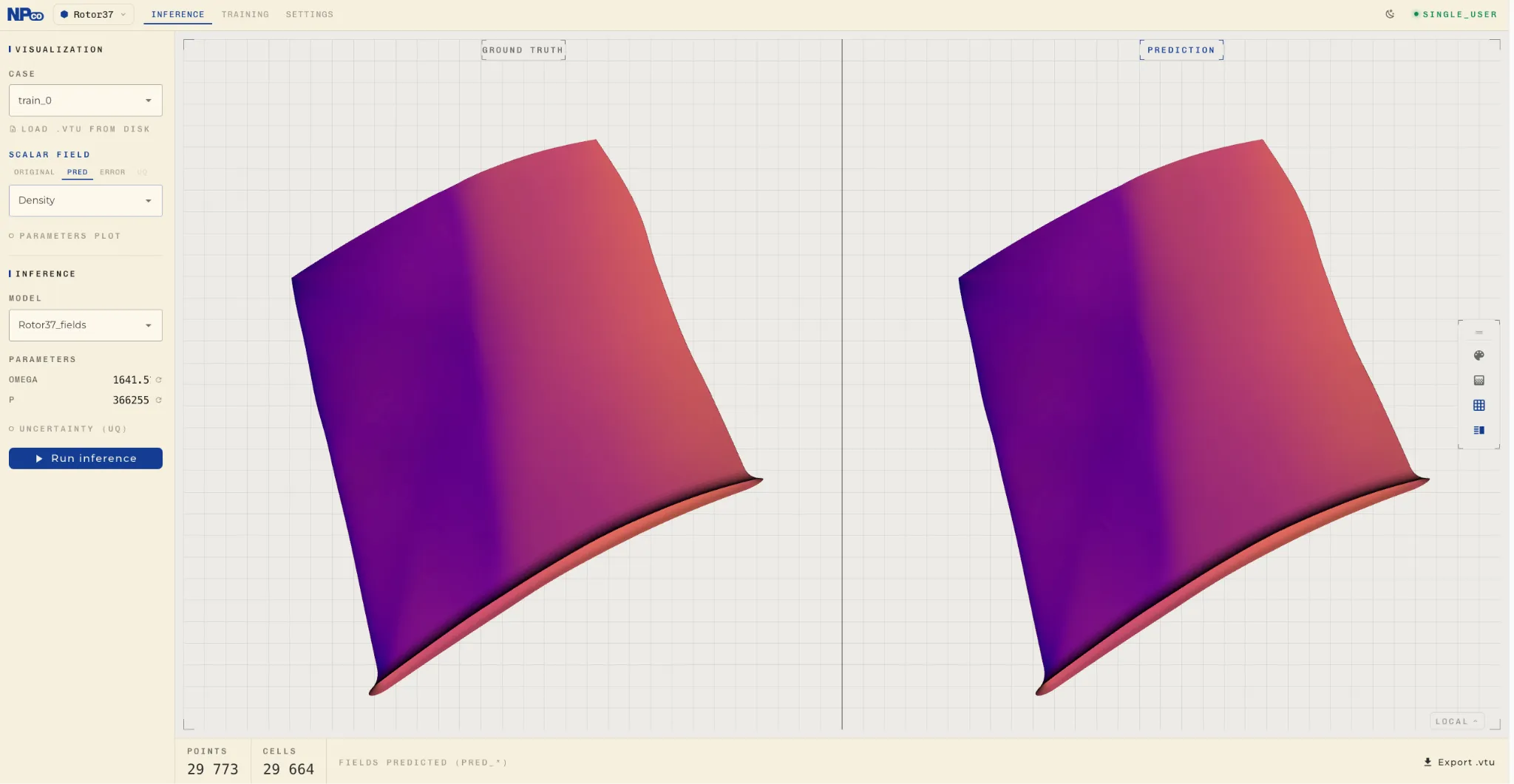
A trained surrogate instead takes the mesh and boundary conditions as input and infers the converged field in one forward pass, in seconds, because the mapping from problem to solution was learned offline. The speed-up does not come from solving faster, it comes from not solving at all.
After a decade of research the open question is no longer whether this works, it is which architecture survives contact with industrial scale.
Where the earlier architectures stopped
The 26.2% satisfaction figure has an architectural history behind it, and practitioners across organizations tell it in remarkably similar terms.
- Physics-informed networks embed the governing equations in the training loss. They remain difficult to train and hard to scale beyond simple geometries, and few industrial teams still consider them a durable route.
- Convolutional networks need structured Cartesian grids, which industrial meshes are not.
- Graph networks solved the geometry problem by operating on mesh connectivity and delivered useful results on components, but message passing becomes prohibitively expensive at full-assembly scale and information propagates only as far as the network is deep.
- Neural operators learn mappings between function spaces with elegant theory behind them, but published results repeatedly show fragility outside the training distribution and an appetite for data that industrial practice cannot feed.
Each family performs well on academic cases of a few thousand points and then hits a wall of scalability, data hunger, or both. An 85% experimentation rate combined with a 26.2% satisfaction rate is roughly what one would expect a community to report after running into those walls at scale.
Attention, tokens, and why scale is the point
A transformer represents its input as a sequence of tokens and updates each token by weighing its relationship to every other token through self-attention. For simulation, two consequences of that design matter.
Long-range coupling is native. In language, attention is what connects a pronoun to a name forty words back. In a physical field, the same mechanism lets a disturbance at the inlet inform the prediction at the outlet directly, without the information hopping through local neighborhoods the way it must in a graph network. Global coupling is the defining feature of elliptic and mixed PDE systems, and here it is a property of the architecture rather than something approximated by stacking depth.
Transformers scale, and scale is where the others failed. They are the only architecture with a sustained record of absorbing large heterogeneous datasets and improving as they grow. A model pre-trained across a broad corpus of physical simulations has already seen how fields behave near walls, how boundary layers develop, and how stress concentrates at features. Adapting it to a new industrial case becomes a fine-tuning problem of tens of cases rather than hundreds. The expensive data requirement moves out of each project and into a pre-training effort amortized across all of them.
The catch, and how the field is resolving it
There is a genuine reason nobody simply used a transformer on a mesh years ago. Self-attention is quadratic in the number of tokens, and standard transformers were built for 1D text sequences or regular 2D image grids. An unstructured industrial mesh is neither, and treating each of ten million mesh points as a token is computationally out of the question.
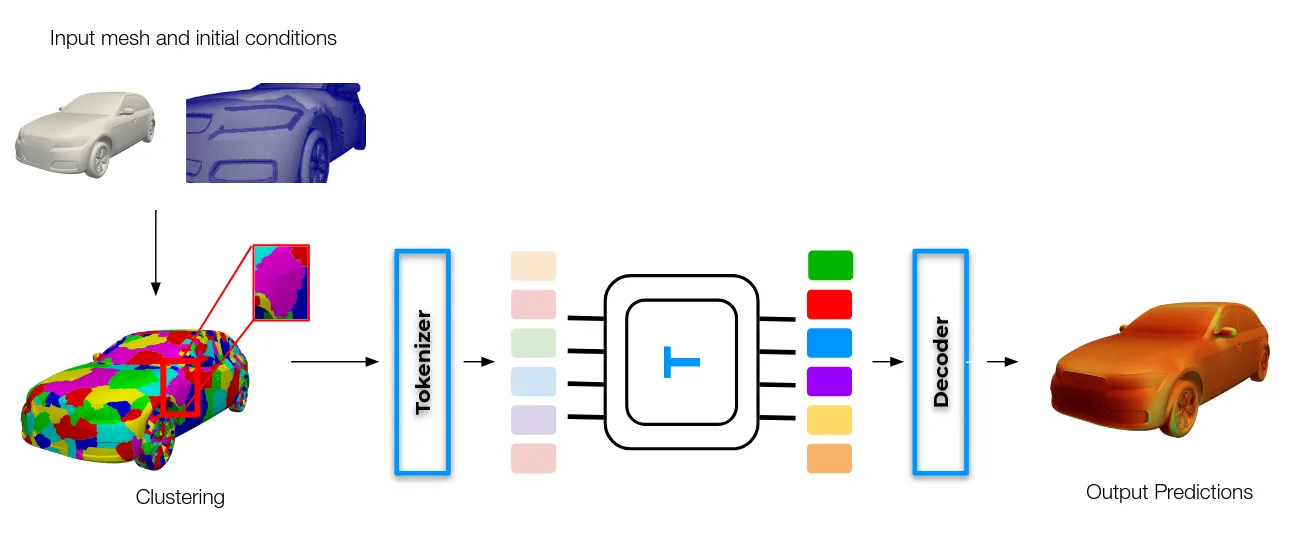
Several groups, working independently, arrived at the same insight: a token has to represent more than a single mesh point. The fix is essentially domain decomposition. The mesh is partitioned into a far smaller number of regions, each region is condensed into one token carrying its geometry and local fields, and attention operates on regions rather than raw points. Transolver, developed at Tsinghua University, groups points by physical state rather than spatial position and computes attention over those groups in linear time [1]. Other published designs make different choices at each step [2] and land in the same place.
The quadratic cost is gone. Mesh sizes that disqualified AI methods two years ago are becoming routine. Physics is governed by consistent laws, so these models do not need to memorize the ambiguity of human language: published models in this family run from a few million to a few tens of millions of parameters. The training bill looks like a workstation invoice rather than a data-center one, and it is small next to the HPC allocation the model then displaces.
- 100M+ cells per industrial CFD case, on a single GPU in a matter of days
- 1000x smaller than a large language model