Research

·

AI in simulation: the adoption paradox

Survey report

·

June 10, 2026

AI in simulation: the adoption paradox

This report presents the findings of a consultation with leading experts, researchers and manufacturers in numerical simulation, run for the 2026 NAFEMS and Teratec event "AI and numerical simulation" on June 10, 2026. It looks at where AI deployment stands among the manufacturers who took part, the barriers they run into and the solutions now emerging.

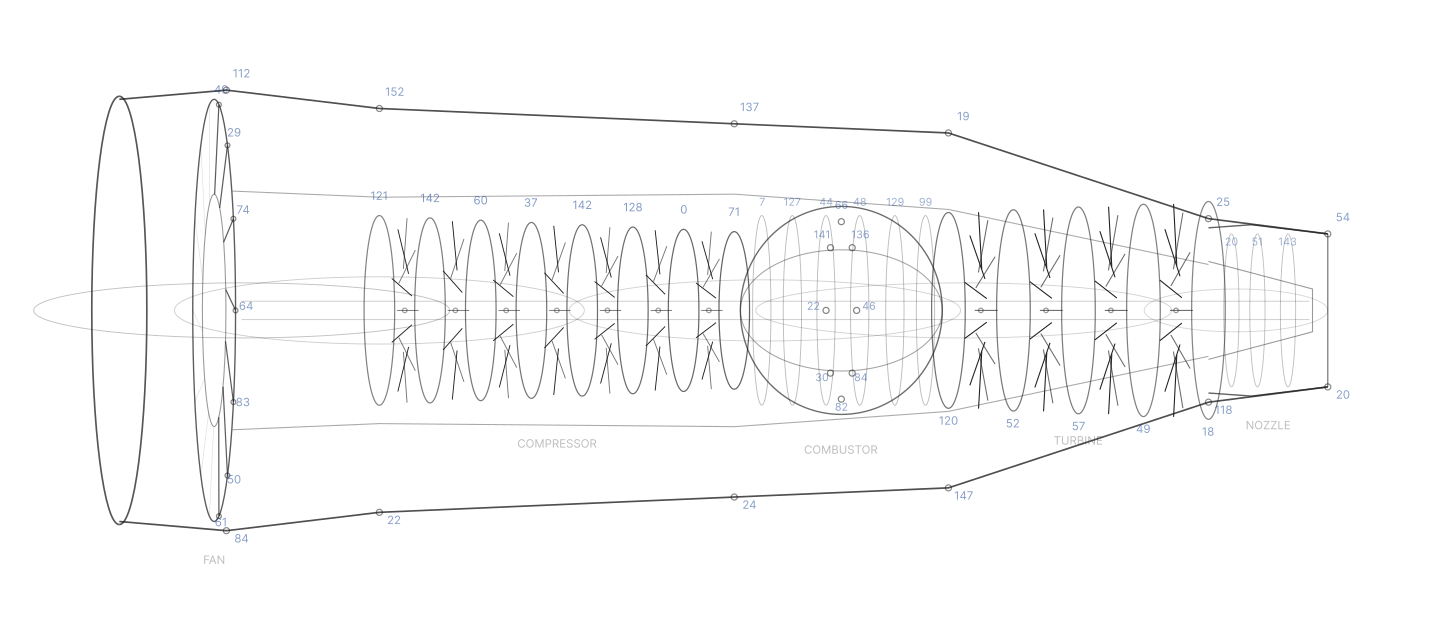
Wireframe of a turbine blade, the kind of geometry studied in industrial simulation

Key findings

85%

of the organizations surveyed have begun testing or deploying AI in their simulation workflows

26.2%

report operational satisfaction with what those initiatives delivered

5%

of the engineers surveyed have experimented with transformer architectures in their simulation workflows

01 · The finding

From experiment to production: the missing link

85% of the organizations surveyed have begun testing or deploying AI in their simulation workflows. Of those, only 26% say they are satisfied operationally, a sign that scaling from pilot to production is still hard.

  1. [01]

  2. [02]

  3. [03]

  4. [04]

Fig. 01 · Share of respondents, up to 3 answers per respondent

Main barriers to adoption

Lack of usable data | 51 Moving from PoC to production | 49 Trust and validation of results | 47 Budget constraints | 37 Resources and skills | 30 Internal buy-in and prioritization | 23

Fig. 01 · Share of respondents, up to 3 answers per respondent

02 · The obstacles

Training data is the biggest obstacle

Almost half of respondents name the lack of usable data and the difficulty of reaching production as their main barriers to deployment.

Traditional architectures (GNN, PINN, ROM) struggle to scale to industrial meshes and start over on every project, with no way to reuse the data built up across earlier simulation campaigns.

  1. [01]

  2. [02]

  3. [03]

  4. [04]

03 · Emerging architectures

Transformer architectures are still underused

Architectures built on pre-trained transformers cut the amount of data needed by relying on pre-training tailored to a specific area of physics. Even so, they are still very rarely used in industrial simulation workflows today.

5% of the engineers surveyed have experimented with transformer architectures in their simulation workflows.

  1. [01]

  2. [02]

  3. [03]

  4. [04]

04 · The application horizon

Toward hybrid models and production deployment

Manufacturers are aiming beyond faster design tools. They want to move toward horizontal applications that can pool data from many different sources. The use case they rate highest is hybrid modeling, which combines simulation data with field measurements and feeds straight into production.

These applications are only feasible with AI-based simulators that can correlate heterogeneous data streams (3D displacement fields, IoT sensor time series, manufacturing metadata), which traditional tools cannot handle.

  1. [01]

    Hybrid models (field and simulated data)

  2. [02]

    Topology optimization

  3. [03]

    Fast surrogate models

  4. [04]

    Real-time AI simulation (CAD)

References

·

About the authors

Emmanuel Menier, CEO of NPco

Emmanuel Menier

CEO, NPco

Emmanuel is an aerospace engineer and has been working on simulation for the past ten years both in academia and the industry. Emmanuel obtained his Ph.D. in AI for simulation from one of the top universities in France, and has published work with world class experts in both Europe and the US.

LinkedIn
Matthieu Nastorg, CTO of NPco

Matthieu Nastorg

CTO, NPco

Matthieu is a mathematician with a strong foundation in applied mathematics. He began his career as a simulation engineer at a biotech startup, where he applied mathematical models to real-world medical challenges. Building on this experience, he pursued a Ph.D. at Paris-Saclay University on AI for simulation, in collaboration with France's national institute for research in digital science and technology (Inria) and IFP Energies Nouvelles.

LinkedIn

Full report · PDF

Get the full results

All seven survey questions and their results, in one PDF.

Try it on a problem you have already solved.

Bring a case your team is working on, and we’ll show you what our AI model can do.

Talk to an engineer